Use the same inspection order every time
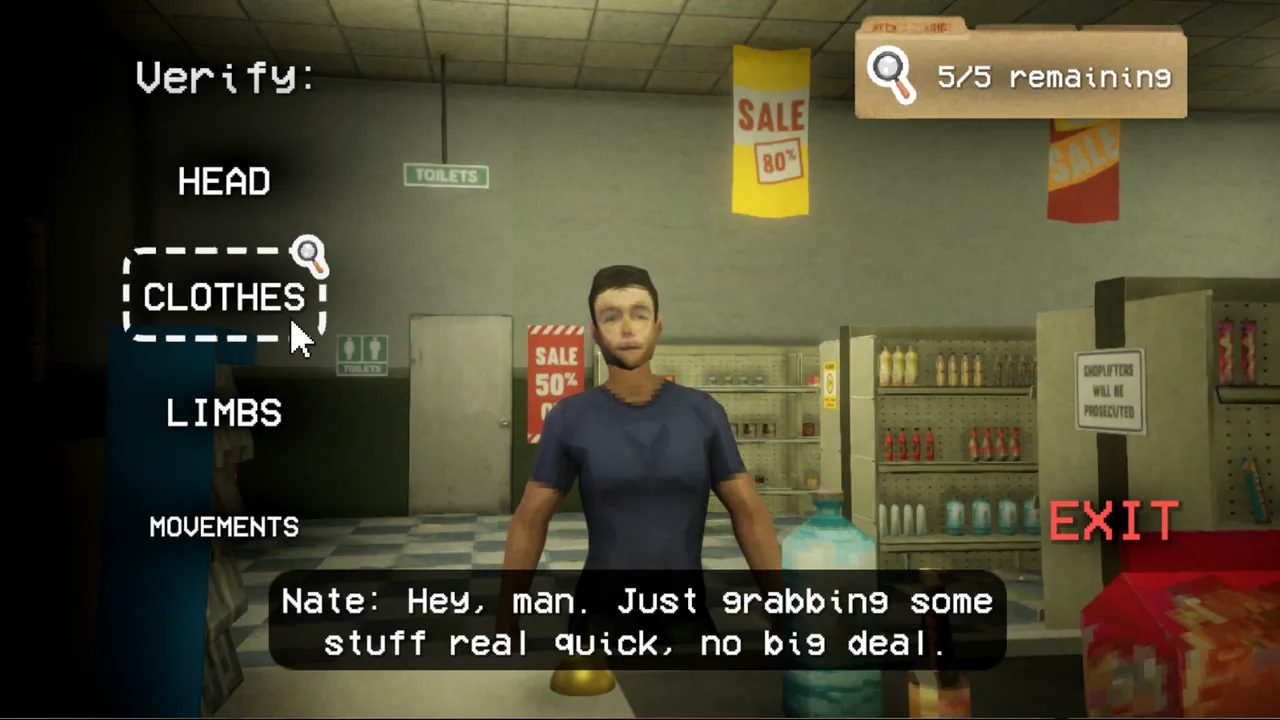
Shift at Midnight gives you several ways to test a customer: ask up to five questions, inspect their ID, cross-check details on the terminal, and observe behavior. The five-question limit is stated on the official Xbox listing; the safest habit is consistency.
- Pause and frame the customer. Finish the previous task and give the counter your attention.
- Read the presented ID. Check each visible field rather than only the portrait.
- Use the five-question allowance. Listen to each complete response instead of rushing to the next prompt.
- Open the computer record. Compare field by field; do not rely on a vague sense that the record “looks right.”
- Observe behavior again. Paperwork and behavior are separate evidence channels.
- State the evidence. In co-op, one player summarizes before the final call.
Separate observations from conclusions
Say “the date does not match the terminal” instead of “this one feels fake.” Precise calls let teammates verify the same fact. They also make a failed decision useful: after the shift, you can identify which comparison was skipped.
| Weak call | Better call |
|---|---|
| “They look weird.” | “Hold—checking behavior after the record.” |
| “The ID is bad.” | “The ID field and terminal record differ.” |
| “Just let them go.” | “No mismatch found after ID, questions, and behavior.” |
Avoid common counter failures
Familiarity bias
A familiar model or name is not proof. Randomized shifts are designed to prevent a single memorized sequence from solving every encounter.
One-check decisions
Do not treat a clean ID as permission to skip the terminal and behavior check. Conversely, do not treat one moment of uncertainty as a substitute for evidence.
Co-op cross-talk
Give one player the final counter call. Other players can report evidence, but simultaneous verdicts create mistakes.
Entity Warning: A doppelganger allowed to leave can return as a monster. Investigation is part of the survival phase, not optional flavor.
If you think you missed one
Stop starting low-value store tasks, communicate the possible miss, and prepare the station’s defensive options. Keep routes clear, locate barricade and trap interactions, and identify a fallback hiding place. Do not assume a weapon is the answer to every entity or every phase.
The Doppelganger Files will add named cases only when repeatable observations are available.
For how this investigation competes with quota work, deliveries, fuel service, inventory, and later defense, open the complete shift systems guide.